


FUPA Meaning: What It Is, Why It Happens & Why You’re Not Alone
You saw the word somewhere. Maybe a Reddit thread. Maybe a TikTok comment section. Maybe someone said it out loud and you smiled and nodded like you knew. The FUPA meaning isn’t exactly taught in school — but it shows up everywhere once you start noticing it.
So here’s the plain truth, no filler.
What is FUPA Meaning?
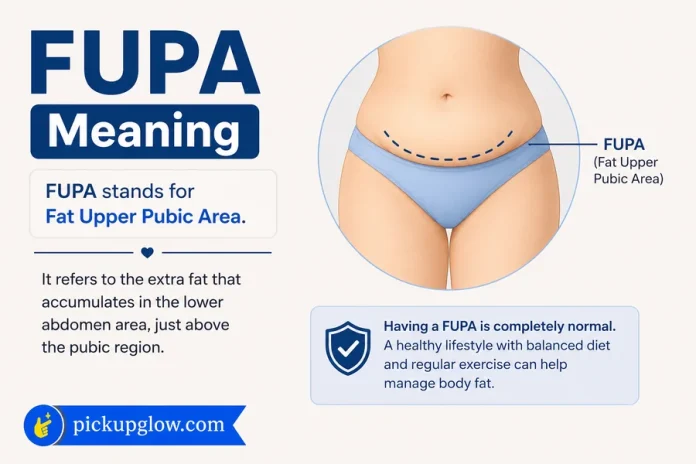
FUPA meaning: FUPA stands for Fat Upper Pubic Area.
That’s it. It refers to the pocket of fat that sits just above the pubic bone, below the belly button. Real anatomy. Real body parts. And a term that doctors, fitness coaches, and regular people all use — sometimes in the same sentence.
The clinical name for this region is the panniculus or the mons pubis area. But nobody Googles that. They Google FUPA — because it’s the word that actually stuck in everyday language.
It’s blunt. That’s probably why it survived.
FUPA Meaning Across Platforms
The word means the same thing everywhere. But the way it gets used? That changes a lot depending on where you are online.
| Platform | How “FUPA” Gets Used | Vibe |
| Medical & Fitness Sites | Anatomical fat zone above the pubic bone | Clinical, matter-of-fact |
| Reddit & Forums | Weight loss journeys, postpartum bodies, real talk | Candid, supportive |
| Twitter / X | Humor, sometimes self-deprecating commentary | Casual, unpredictable |
| TikTok | Body image content, workout tips, trending sounds | Ranges from empowering to comedic |
| Urban Dictionary | Exaggerated or satirical spins on the term | Crude, not always accurate |
| News & Celebrity Coverage | Body shape references in pop culture moments | Varies wildly |
The core FUPA meaning holds steady in health spaces. Everywhere else, the tone does the shifting — not the definition.
Read Also: Diabolical Meaning
Similar Terms Worth Knowing
People use a handful of words interchangeably here. They’re not all the same thing — but they’re in the same neighborhood.
| Term | What It Actually Means | Where You’ll See It |
| FUPA | Fat Upper Pubic Area | Medical, fitness, casual conversation |
| Panniculus | Excess abdominal skin or fat fold | Clinical and surgical settings |
| Mons pubis | The formal anatomical name for that region | Medical textbooks |
| Apron belly | Overhanging fat below the navel | Body positivity spaces |
| Belly pooch | Soft protrusion in the lower abdominal area | Fitness blogs, lifestyle content |
| Muffin top | Fat that spills over a waistband | Fashion, casual slang |
| Lower belly fat | General descriptor for fat in that zone | Fitness content everywhere |
FUPA is specific. It targets the upper pubic region — not the waistband, not the whole stomach. That distinction matters if you’re researching workouts or looking into medical options.
Why People Search This Term
Not everyone searching “FUPA meaning” is looking for the same thing. Some people just saw the word and want a definition. Others are postpartum and trying to understand what’s happening to their body. Some are deep into a fitness plan and want to know if what they’re targeting even has a name.
It does. And that’s half the reason this keyword gets so much traffic.
The FUPA sits at the intersection of body image, health, and internet culture. Those three things together? That’s a search term with legs.
FUPA After Pregnancy — Why It’s So Common
Nobody tells you about this part.
You have the baby. You expect your body to more or less return to normal. And then weeks later, there’s still this soft pouch sitting just above the pubic area — and it doesn’t seem to be going anywhere.
That’s a FUPA. And it happens to a huge number of women after pregnancy.
During pregnancy, your body deliberately stores fat in the lower abdominal and pubic region — it’s protective, hormonal, and completely intentional from a biological standpoint. After delivery, that fat doesn’t just disappear because the reason for it is gone. Add in C-section recovery, disrupted sleep, hormonal recalibration, and reduced movement — and it becomes clear why the fupa often sticks around longer than expected.
This isn’t something gone wrong. It’s your body doing what bodies do.
Still — a lot of women want to understand it, address it, or at least stop feeling blindsided by it. That’s a legitimate thing to want.
Getting Rid of a FUPA — What Actually Works
No shortcuts here. But yes — it responds to the right approach.
Fat loss has to happen body-wide first. You cannot spot-reduce. No amount of lower ab exercises will specifically burn fat from the fupa area. What works is creating a caloric deficit consistently over time so your body pulls from fat stores — including that region.
Strength training builds the structure underneath. Exercises like planks, dead bugs, pelvic tilts, and leg raises build the muscles beneath the fat. That matters both for appearance and for core function.
Cardio supports the overall process. It increases your caloric burn and keeps fat loss moving. It doesn’t have to be intense — consistency beats intensity for most people.
Surgery exists for cases where lifestyle changes aren’t enough. A panniculectomy removes excess fat and skin from the lower abdominal area. A tummy tuck — technically an abdominoplasty — goes further, tightening the underlying muscle wall. Both are real procedures with real recovery periods and specific candidacy requirements. Not a casual option, but a legitimate one for some.
The fupa does respond to sustained effort. It just takes longer than people want it to.
How FUPA Went from Slang to Mainstream
The word didn’t come from nowhere. It had been floating around gym culture and internet forums for years before it broke into mainstream coverage around 2016 — mostly through celebrity tabloid content and music references. After that, it was everywhere.
TikTok gave it a second wave. Body positivity creators started using the term openly — not to shame, but to normalize. Postpartum mothers shared their bodies. People in the middle of weight loss journeys talked about the fupa honestly instead of dancing around it. That kind of content resonated.
On Twitter, it runs more toward humor. Self-deprecating jokes, memes, the usual. But even there, the underlying FUPA meaning is understood.
It now exists in this odd space between clinical language and cultural shorthand. That’s rare for a slang term — and it’s exactly what keeps it ranking.
Is It Offensive?
Here the context does the work.
If a doctor is using it in a consultation, then that’s communication. A fitness coach who uses it with the client who mentions it first — also OK. In those contexts, the word implies nothing derogatory.
Refer to another person, without asking permission? That’s where it turns. When aimed at another person by accident, it may come off as body shaming.
Many use the term about themselves in communities where body acceptance is common. The reclamation is authentic. However, this does not logically translate to other people’s use.
The FUPA meaning is neutral. Not everything around it is always.
Read Also: FN Mean in Text
Fast Answers to FUPA
| Question | Answer |
| What does FUPA stand for? | Fat Upper Pubic Area — fat tissue that sits above the pubic bone |
| Is FUPA a medical term? | Not officially, but it’s widely used in clinical and fitness contexts |
| Can you get rid of a FUPA? | Yes — through sustained diet changes, exercise, or surgical options like panniculectomy |
| What causes a FUPA? | Weight gain, pregnancy, hormonal shifts, and genetics all play a role |
| Is FUPA only for women? | No — men develop it too, though the conversation tends to center on women’s health |
| What does FUPA mean on TikTok? | Same thing — fat upper pubic area — often in body image or fitness content |
| Is FUPA offensive? | Depends on context. Neutral in medical use. Can feel pointed in casual conversation |
Related Terms
- Lower belly fat
- Pubic area fat accumulation
- Post-pregnancy body changes
- Panniculectomy recovery
- Subcutaneous vs visceral fat
- Abdominal fat reduction
- Hormone-related weight gain
- Core strengthening for women
- Body positivity and self-image
- Tummy tuck before and after
Bottom Line
FUPA meaning is Fat Upper Pubic Area. It’s a real anatomical zone, a real search term, and a real part of how people talk about their bodies online and off.
The reason it keeps trending isn’t shock value. It’s because people want honest language for real things — and this word delivers that. Whether you found it on social media, in a fitness article, or through a medical search — the meaning is the same.
And now you have it.
FAQs:
Q: What does FUPA stand for?
FUPA stands for Fat Upper Pubic Area. It refers to the buildup of fat just above the pubic bone and below the belly button.
Q: Is FUPA a real medical term?
It is not an official medical term, but it is widely used in fitness, health, and clinical conversations. The formal name for the same region is the panniculus or mons pubis.
Q: What causes a FUPA?
The main causes are weight gain, pregnancy, hormonal changes, and genetics. The body naturally stores fat in this area, especially during and after pregnancy.
Q: Can you get rid of a FUPA?
Yes. Consistent fat loss through diet and exercise reduces it over time. In some cases, surgical options like a panniculectomy or tummy tuck are considered.
Q: Does FUPA affect men too?
Yes. Men develop fat in the upper pubic area as well. The conversation tends to focus on women, but it is not exclusive to them.
Q: What does FUPA meaning on TikTok?
On TikTok, FUPA carries the same meaning — Fat Upper Pubic Area. It appears most often in body positivity content, postpartum discussions, and fitness videos.
Read More Articles: Evil Eye Meaning