

Elope Meaning: What the Word Actually Means Today
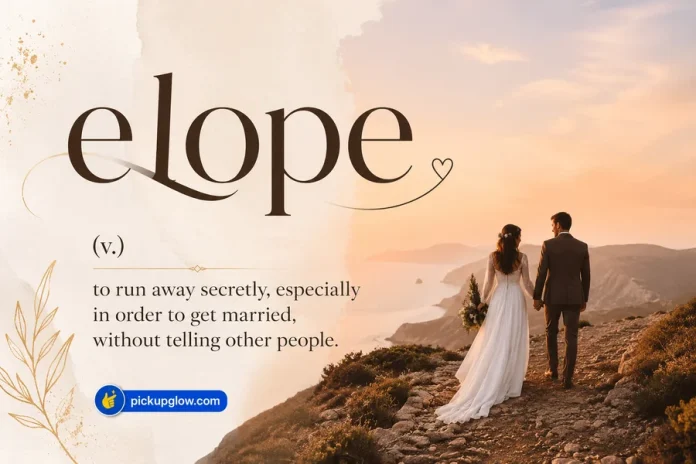
The elope meaning is straightforward. You leave quietly, get married, and skip the big event entirely. No venue deposit. No catering drama. Just two people and a decision.
That is the short version.
The longer one is more interesting.
Elope comes from an old Anglo-French root — aloper — meaning to run away. For most of history that was literal. Couples who eloped were usually running from something. Disapproving parents. Class differences. Arranged marriages. The word carried real weight.
Today it means something much softer. Most people who elope are not running from anything. They are just choosing a different kind of day.
The Core Definition
Elope: To marry secretly, now often by conscious decision, without a ceremony or large crowd.
The turning point is that it’s moving from secret to purposeful. It provides an explanation for why the word is still used in 2026 despite their awareness.
Elope Meaning Across Different Contexts
| Context | What it means | Example |
| Traditional | Marry in secret, without family approval | “They eloped at midnight — her parents had no idea.” |
| Modern | Get married quietly, by choice, with almost no guests | “We eloped in Portugal — just us and the officiant.” |
| Wedding industry | A planned micro-ceremony, often at a scenic location | “Elopement packages” for 2–10 people at national parks. |
| Legal | Marriage with no formal ceremony — just the paperwork | Courthouse sign-and-done. Fully legal, zero fanfare. |
| Medical / care | A patient leaving a care facility without permission | “The patient eloped from the ward undetected.” (clinical use) |
| Literary | To flee or escape — not always about marriage | “She eloped from her guardian’s house before dawn.” (older usage) |
How the Elope Meaning Changed
A hundred years ago, eloping was a last resort. Families held real power over who their children married. Social standing, religion, money — all of it played into who got approved. If a couple eloped, it often meant burning bridges.
That version of the elope meaning still exists in literature and film. But in real life it has mostly faded.
Now people elope because they want to. Not because they have to.
The wedding industry actually helped push this shift. Photographers started specializing in elopements. Venues started offering small packages. The word lost its scandal and kept its romance. That is a pretty good trade.
Eloping vs. a Courthouse Wedding — Not the Same Thing
People mix these up. Here is the difference.
A courthouse wedding is a location. You go to a government building, sign papers, and it is done. You can bring guests. You can dress up. There is nothing inherently private about it.
Eloping is an intention. It is about choosing smallness. Whether that happens at a courthouse, a cliff edge, or a stranger’s garden — the defining feature is intimacy. Not the address.
You can elope at a courthouse. But showing up to city hall with 40 people in tow is not eloping. That is just a cheap wedding.
Similar Terms and Alternatives
| Term | What it means | Key difference | Example |
| Elope | Marry privately or in secret | Secrecy or strong privacy is the point | “We eloped in Vegas.” |
| Micro-wedding | Small wedding, under ~30 guests | Still has guests, structure, and a plan | “20 people, backyard, done.” |
| Run away together | Leave secretly with a partner | Does not always mean marriage | “They ran away to start over.” |
| Intimate wedding | Small ceremony with close people | No secrecy — openly planned | “Immediate family only, at home.” |
| Civil ceremony | Legal, non-religious marriage | About legality, not atmosphere | “Courthouse. Fifteen minutes.” |
| Abscond | Leave secretly to avoid consequences | No marriage meaning. Usually negative. | “The suspect absconded overnight.” |
| Destination wedding | Wedding held in a travel location | Can be large — fully planned event | “Santorini, 60 guests, open bar.” |

Why People Actually Elope
Not for one reason. For many.
Money. The average US wedding runs well past $30,000. Eloping can cost a few hundred. That gap is hard to ignore when you are also buying a house or paying off student debt.
Pressure. A wedding involves a lot of people with a lot of opinions. At some point the day stops being yours. Eloping fixes that.
The day itself. Some couples just want to get married — not manage an event. The elope meaning, for them, is about focus. What actually matters versus what just looks good on paper.
Location freedom. You can elope anywhere. A mountain in New Zealand. A city hall in Lisbon. A state park two hours from home. The ceremony goes where you want it.
Read Also: Pars Meaning
Does Eloping Skip the Legal Part?
No. And this is worth knowing clearly.
You still need a marriage license. Every jurisdiction has its own rules — most require both people to appear in person, and some have a waiting period between applying and marrying. None of that goes away when you elope.
After the ceremony, you receive a marriage certificate. Keep it. You will need it for name changes, tax filings, insurance updates, and anything else that ties your lives together legally.
The elope meaning covers the experience. The paperwork is still the paperwork.
Elope in Culture — Then and Now
Austen readers know this one. When Lydia Bennett runs off with Wickham in Pride and Prejudice, the whole family treats it as a catastrophe. That was the elope meaning in the 1800s — reckless, ruinous, talked about in whispers.
Flip forward to modern romantic comedies. Eloping is the good ending. The couple finally stops waiting and just does it. Same word. A completely different feeling.
That says a lot about how marriage — and expectations around it — have shifted. The secrecy is gone. The romance stayed.
Read Also: IIRC Meaning
Related terms
- Elopement
- private wedding
- intimate ceremony
- civil marriage
- marriage license
- marriage certificate
- secret wedding
- small wedding
- spontaneous wedding
- run away to get married
- wedding without guests.
What the Elope Meaning Comes Down To
It’s not a secret. It was never really about that — at the core of it.
It is the way of selecting each other without all of the noise. When he was 1890 that meant running away from home. There could be two flights in 2026 and post-facto to others. In either case the impulse is the same.
The elope meaning has held up because the feeling behind it has not changed. Two people. A decision. All optional with the exception of everything.
FAQs:
Q: What does elope mean?
Elope meaning is to get married privately — traditionally in secret without family approval, and today by deliberate choice with few or no guests. The core meaning is the same: skip the big event and just get married.
Q: Is eloping legal?
Yes. Eloping is completely legal. You still need a valid marriage license and an authorized officiant. The ceremony is private — the paperwork is not optional.
Q: What is the difference between eloping and a courthouse wedding?
A courthouse wedding is a location. Eloping is an intention — choosing privacy and smallness regardless of where the ceremony happens. You can elope at a courthouse, but the two are not the same thing.
Q: Do you need witnesses to elope?
It depends on where you marry. Some states and countries require one or two witnesses. Others do not. Always check local marriage law before you plan.
Q: Can you elope and still have a reception?
Yes. Many couples marry privately first and celebrate with family and friends later. The legal ceremony and the party do not have to happen on the same day.
Q: Why do people choose to elope?
Most couples elope to avoid wedding stress, cut costs, or simply keep the day personal. It is less about secrecy now and more about choosing what the day actually feels like.